Send a message

Send a message

info@septronmachineries.com
(+91) 95859-37419
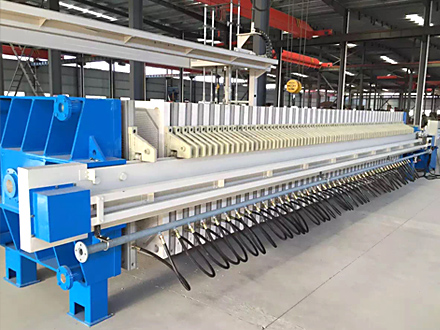
The working room of the membrane filter press consists of chambers, limited by two adjacent plates with recesses in the central part. Unlike the chamber plates, the drainage draining the filtrate is located on movable membranes serving for pressing and “wringing” of the filtrated cake. Water or air under pressure is used to compress the membranes. Once the filter press is filled with the suspension, this medium is fed to the room under the membranes and its subsequent lifting compresses the cake and pushes out the residual liquid. The liquid passes through the cloth and is discharged out of the filter press. The thickness of the filtration chamber is usually 30 – 50 mm before compressing, by compressing the membrane it is reduced most often by 20 – 40%.The suspension is fed via a central or corner inlet passing through the whole set of plates. The filtrate is drained by drainage on the membrane surface (under clothes) and then by channels drilled inside the plates out of the filter press. Filtrating (filling) pressure before the start of the membrane compression is usually 8 bars, it rises up to 15 bars during compressing (structurally, we manufacture filter presses to a maximum pressure of 30 bars).The filter presses are equipped with a security system, which will not enable opening of the filter presses if the system of membrane compression was not previously decompressed. This prevents from damaged to the membranes by accidental opening of the filter press. The filtration plates including membranes are standard made of polypropylene, another material can be chosen.
We also export high pressure membrane filter press to several clients across the world. Our company manufactures membrane filter presses according to international standards and quality. The membrane squeeze plate is offered to suit up to 16 bar squeezing pressure. Due to additional liquid extraction during the squeeze cycle, a solid percentage increases.
The membrane filter press offered by us is gaining widespread recognition as it reduces disposal costs for filter presses. It also reduces the moisture content, thus making it ideal for new plants.
The membrane squeeze plate is offered to suit up to 16 bar squeezing pressure. Due to additional liquid extraction during the squeeze cycle, a solid percentage increases. Filtration cycle time is reduced compared to the conventional recess chamber plate (Plate and Frame) filter press, resulting in benefits of membrane plates v/s camber plates.